
Mont-Saint-Michel Guide: Tides, Abbey Tickets, Getting There
Mont-Saint-Michel is a tidal island crowned by an abbey in Normandy, part of the UNESCO-listed Mont-Saint-Michel and its Bay. The village is free to enter; the abbey requires a ticket, with individual admission at €13 from October 2026 through March 2027, so check the official site before you go. Park on the mainland, use the free shuttle, and expect roughly 350 steps via the main street and abbey; as planning advice, set aside half a day to a full day on site.
Build your visit around three separate checks: your transport connections, the abbey's opening hours, and the tide table. If this is one stop on a wider coastal trip, the Brittany vs Normandy comparison can help you plan the surrounding days.
Mont-Saint-Michel at a glance
The Mont sits in the Manche department of Normandy, near the Brittany border. Keep the village and abbey separate when planning: access to the streets does not mean the monument is open.
| Planning question | Quick answer |
|---|---|
| Village admission | Free; no entry ticket or reservation |
| Abbey hours, September–April | 9:30 a.m.–6 p.m.; last entry 5 p.m. |
| Abbey hours, May–August | 9 a.m.–7 p.m.; last entry 6 p.m.; closed May 1 |
| Individual abbey ticket | €13, October 1, 2026–March 31, 2027; check the official site |
| Steps | About 200 in the Grande Rue, then 150 inside the abbey |
| Nearest train station | Pontorson, 9 km (5.6 miles) away |
For a shorter visit, prioritize the abbey and a walk along the ramparts. Give yourself more room if you want a meal, a guided bay walk, or time to watch the tide. These are itinerary choices, rather than a fixed sightseeing duration.
Getting there from Paris
There is no single rail route to use in every season. The tourist office lists the following combinations; the times below describe individual legs, not the complete journey or waiting time between connections.
| Rail route from Paris | Onward connection |
|---|---|
| TGV from Montparnasse to Rennes, about 2 hours | Keolis bus to the Mont, about 1 hour 10 minutes |
| TGV from Montparnasse to Rennes | TER train to Pontorson, then bus |
| TGV from Montparnasse to Dol-de-Bretagne, about 2 hours 40 minutes | Bus to Pontorson, then bus to the Mont |
| Year-round TER/Nomad route to Villedieu-les-Poêles | SNCF bus to the visitor parking area |
| Summer Nomad route from Montparnasse to Pontorson | Direct bus connection to the Mont |
| Nomad from Saint-Lazare to Caen | TER to Pontorson, then onward bus |
Check SNCF Connect for the current timetable, and check Keolis Armor for its bus connections. Confirm the return trip before committing to an abbey visit time. The France train travel guide explains the wider rail-planning basics.
Driving from Paris, the tourist office gives two routes: A13 toward Caen followed by A84 toward Avranches/Rennes, or A11 toward Le Mans, A81 toward Fougères, then A84 toward Caen. Both end with mainland parking and the final approach to the Mont.
For the choice between an organized excursion and independent travel, see the France day tours comparison.
Parking and the free shuttle
Visitor parking is on the mainland, about 2.5 km (1.5 miles) from the Mont's entrance. Follow signs for the free Le Passeur shuttle, which runs approximately every 15 minutes during regular service hours, or walk to the village entrance in about 40 minutes.
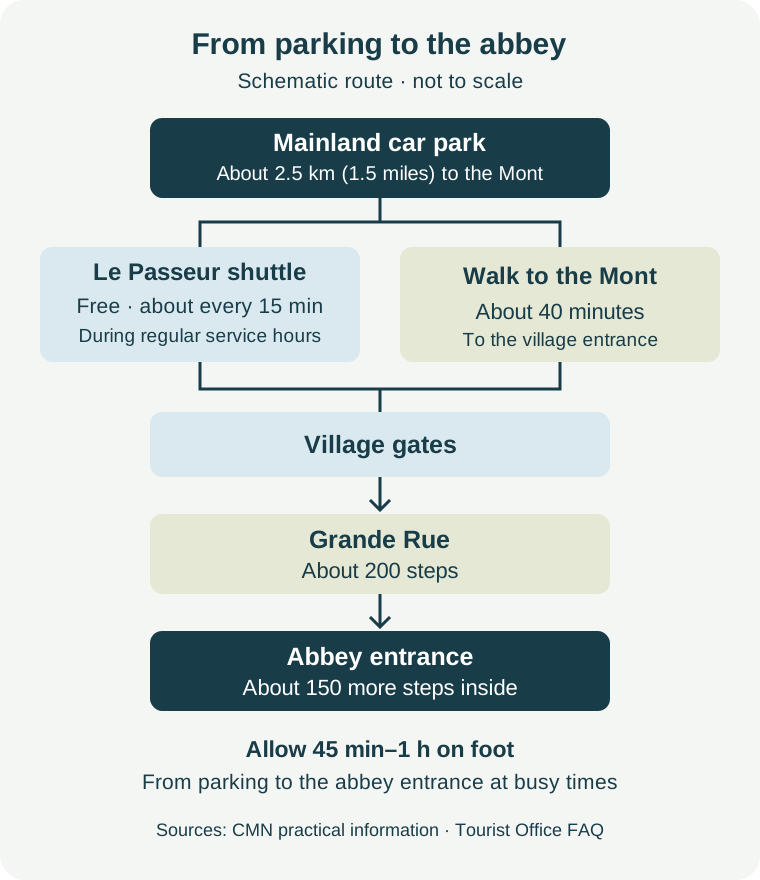
The village entrance and the abbey entrance are different endpoints; leave time for the climb.
The parking areas are numbered P2–P13. P2 serves people with reduced mobility; P3 is reserved for village hotel guests with a code. P8 is for motorhomes, with a 24-hour maximum, and P9 is for bicycles and motorcycles. Motorhome parking is not an overnight accommodation area: sleeping there is prohibited.
Parking is open 24/7. Take a ticket on entry and pay at the machines before leaving. Charges renew every 24 hours and include the shuttle and Tourist Information Centre services, including toilets and information. Use the official parking page and its current price list to check charges.
| Period | Regular Le Passeur hours |
|---|---|
| November–February, excluding school vacations | 8:30 a.m.–10 p.m. |
| March–June and September–October; All Saints, Christmas, and winter school vacations | 7:30 a.m.–11 p.m. |
| July–August | 7 a.m.–1 a.m. |
Outside these hours, transport is available on demand at +33 (0)2 14 13 20 15. For an abbey booking, CMN advises allowing about 45 minutes to one hour on foot from parking to the abbey entrance, depending on crowds. Build in additional margin if you need breaks.
Visiting the abbey
The abbey stands above the village. Its regular opening hours are 9 a.m.–7 p.m. from May 1 through August 31, and 9:30 a.m.–6 p.m. from September 1 through April 30. It is closed January 1, May 1, and December 25. Last admission is one hour before closing.
Tickets and free admission
CMN publishes these dated individual rates:
| Ticket period | Individual admission |
|---|---|
| April 1–September 30, 2026 | €16 |
| October 1, 2026–March 31, 2027 | €13 |
These periods do not establish the price for summer 2027. Check the official abbey practical information and ticket link before you go. Online booking is available.
Free admission includes under-18s visiting with families, and visitors ages 18–25 who are EU citizens or regular non-EU residents of France, subject to CMN's conditions. Admission is also free on the first Sunday of January, February, March, November, and December, and during European Heritage Days. Check eligibility and supporting documents on the official site.
SNCF Nomad Paris–Mont-Saint-Michel passengers presenting their route ticket within five days of travel qualify for a partner rate: €11.50 for October 1, 2026–March 31, 2027, or €13 for April 1–September 30, 2026. Check the official site before you go.
The optional Revelacio tablet guide costs €6 as listed in the practical information checked October 24, 2026; check the official site before your visit. It includes English, and you must leave identification until you return the device.
Steps, bags, and accessibility
The tourist office counts about 350 steps via the Grande Rue and abbey. It says the Fanils entrance can halve the ascent, but this does not make the abbey step-free. CMN describes access as difficult for people with reduced mobility and for strollers; strollers must be folded inside.
- Leave suitcases and large bags elsewhere. Smaller bags below cabin-baggage size are accepted, but the abbey has no luggage storage.
- Expect security gates and a visual bag inspection under the Vigipirate security plan.
- Pets are not permitted, even in carrying bags; guide and assistance dogs are allowed.
- Minors must be accompanied by an adult.
Ask CMN about your particular access needs before buying tickets. A shuttle ride removes the mainland walk, but leaves the climb through the village and the monument's stairs.
The village and the ramparts
Inside Mont-Saint-Michel, the Grande Rue leads through three successive gates: Porte de l'Avancée, Porte du Boulevard, and Porte du Roy. Follow it uphill toward the abbey, with the Saint-Pierre parish church along the village route.
The public rampart walkway connects seven towers and also provides a route toward the abbey. The North Tower is a useful place to look across the bay and observe the rising tide. Allow time to leave the main street rather than treating the village only as an approach to the ticket entrance.
Local food traditions include the Poulards' soufflé omelette and pré-salé, or salt-marsh lamb. The tourist office traces the Poulards' first inn to 1873 and their move to the current premises to 1888. These are regional specialties to recognize on menus, rather than restaurant recommendations.
Tides: when the Mont becomes an island
The bay has continental Europe's largest tidal range, reaching up to 15 meters (49 feet). The sea can retreat as far as 15 km (9 miles) and return quickly. At neap tides, when the tidal range is smaller, the water does not reach the rock.
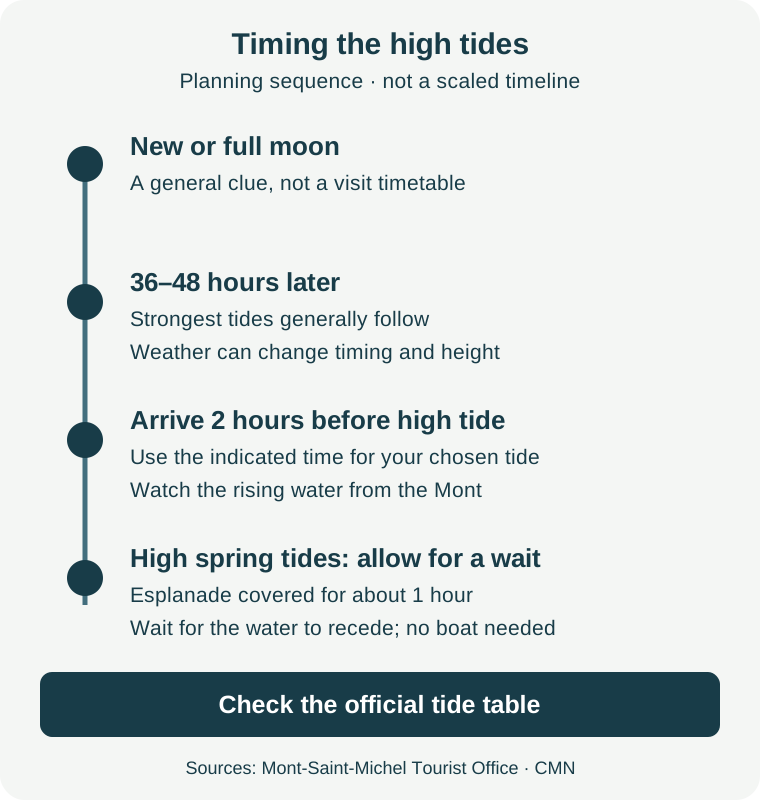
Use the official tide table for your visit; moon phases alone cannot predict access conditions.
The strongest tides generally occur 36–48 hours after a new or full moon, but weather can change the timing and height. CMN highlights the spring and fall equinoxes for especially large tides. To watch the water rise from the Mont, arrive two hours before the indicated high tide.
During high spring tides, water covers the esplanade between the walkway bridge and the village entrance. The Mont becomes an island for about an hour. You do not need a boat: wait for the water to recede before crossing.
Consult the tourist office's tide schedules when planning and again before arrival. Avoid scheduling a tight connection around a crossing that may be temporarily covered.
Walking on the bay: only with a certified guide
Stay on the designated approach unless you are joining a certified bay guide. Quicksand exists, and the tourist office warns that going onto the bay alone is extremely dangerous, including immediately beside the Mont. Exposed sand at low tide is not a safe walking route by itself.
Use the official certified bay-guide directory and filter for English if needed. Before booking, ask about the route, meeting point, required clothing, and suitability for your group. Treat a guided crossing as a separate activity when allocating your day.
Staying overnight
You can stay inside the village. The tourist office describes quieter streets after day visitors leave, giving overnight guests a different setting for exploring the lanes and ramparts. It points to the North Tower for sunrise and the old quay on the west side for sunset.
The monastic community sings Vespers and Lauds in the abbey church, or a crypt in winter. Check arrangements if you want to attend; an overnight room does not extend normal sightseeing hours at the abbey.
For drivers, the accommodation supplies a single-use code for P3, followed by the shuttle to the Mont. Bring light luggage for the remaining climb. La Caserne accommodation is on the mainland between the dam and parking area, with a reservation code for its access barrier. Confirm which location you are booking and how to reach it after regular shuttle hours.
A short history of Mont-Saint-Michel
A sanctuary dedicated to the archangel Michael existed here from 708, and the Benedictine abbey was founded in 966. Construction between the 11th and 16th centuries adapted the buildings to the confined rock. The abbey was abolished in 1789 and used as a prison until 1863. Its spire dates to 1897. UNESCO inscribed Mont-Saint-Michel and its Bay in 1979, recognizing the relationship between the abbey, fortified village, and tidal landscape.
For another part of the region's history, plan a separate visit using the Normandy D-Day beaches guide.
Sources & References
This article is based on first-hand experience and verified with the following official sources:
- Centre des monuments nationaux - Abbey practical information↗
- Mont-Saint-Michel Tourist Office - Frequently asked questions↗
- Mont-Saint-Michel Tourist Office - By car, motorbike and camping van↗
- Mont-Saint-Michel Tourist Office - By train, plane and ferry↗
- Mont-Saint-Michel Tourist Office - Tide schedules↗
- Mont-Saint-Michel Tourist Office - The high tides and the tidal bore↗
- Mont-Saint-Michel Tourist Office - Certified bay-crossing guides↗
- Mont-Saint-Michel Tourist Office - The village and the ramparts↗
- Mont-Saint-Michel Tourist Office - Spend a night at Mont-Saint-Michel↗
- Centre des monuments nationaux - The high tides↗
- UNESCO World Heritage Centre - Mont-Saint-Michel and its Bay↗

Go2France Team
Based in France since 2020 | All 13 regions visited | Updated monthly
We are a team of travel writers and France enthusiasts who explore the country year-round. Our guides are based on first-hand experience, local knowledge, and verified official sources.
More about us →People Also Read
Brittany vs Normandy: The Definitive Comparison
Discover the key differences between Brittany and Normandy. Compare landscapes, villages, activities, and find which region suits your travel style.
Normandy & D-Day Beaches: Complete 2026 Visitor Guide
Visit Normandy's D-Day beaches and historic sites with our complete guide covering Omaha Beach, Utah Beach, the American Cemetery, and the Bayeux Tapestry.

France in Peak Season vs Low Season: Honest Comparison
Peak vs low season in France: costs, crowds, weather, and festivals. Plan smarter with honest trade-offs for each season.

Best Things to Do in France: Experiences Worth Booking
Discover the best experiences to book in France: wine tastings, cooking classes, château tours, and more. Compare operators, prices, and get honest reviews.